New York Daily Photo Analytics

Showing posts with label Secret NYC. Show all posts

Thursday, December 01, 2011

Frontier


It pays to be informed, otherwise you might, like I did in the 1960s, believe you "discovered" a little known, non-touristy area like Times Square (see story here) or that more recently, think you discovered a lesser known structure in Coney Island.

On a recent excursion to Coney Island, my exploration took me a little off the beaten path. Many good things can happen when one Goes West. As I did so, past all the well known attractions and landmarks - the New York Aquarium, the Wonder Wheel, Luna Park, Nathan's, the Cyclone, the area started to feel much like the frontier with abandoned lots and structures. It was at 21st Street and the Boardwalk that I happened upon a building which became more intriguing the more closely I examined it, thinking that I had made another secret "discovery." Only today did I happen upon the photos I had taken and decided to investigate the structure, and I was soon to learn that 2102 Boardwalk was about as obscure as the Times Square of my youth.

Thursday, September 01, 2011

Fatu Hiva


I have always had a fascination with and love of islands. At one time, I pursued that interest much more actively. My fascination was fulfilled with many trips to the West Indies, Fire Island, Martha's Vineyard, Nantucket, and Monhegan Island (Maine), as well as with readings on islands around the world.

Wednesday, August 17, 2011

Not For Tourists


At my business, we have a showroom which adjoins our offices. The separation between the two is an open doorway and a windowed wall, so nothing is hidden from our clientele. We typically have various prototypes, samples, or products for evaluation in the office area.

Regardless of how much inventory or diversity we have in our showroom, invariably people will fixate on some sample in our office, craning and straining to see the object of their desire from the doorway and being careful not to overstep the demarcation between showroom and office. Upon inquiry, we inform them that the product is not for sale. Then the interest really escalates. On occasion, we have had begging, with the customer making the case that this is, in fact, exactly what they need.

Thursday, August 11, 2011

I Doubt It


The story behind 95 Bedford Street is befuddled. Not astounding, really, because no one wants to do primary research anymore. Actual pieces of information, misinformation, conjecture, and extrapolation are all blended together. Pieces are copied and recopied. Variants on all these mixings can be found everywhere. Good luck sorting them out.

Friday, June 10, 2011

It Hurts Me Too


Please Click and Play Audio Clip to Accompany Your Reading:


In the off chance you have not heard, read or seen, the painting over of a sign at 11-13 Minetta Street is BIG International news. It's a media feeding frenzy. In 1958 the Commons opened here. From the 1950s through the 1960s, it became the home of The Fat Black Pussycat Theatre, a legendary beatnik coffee bar which saw the likes of Bill Cosby, Tiny Tim, Mama Cass Elliot, Richie Havens, and Shel Silverstein. It has been said that it may have been here that Dylan wrote "Blowin' in the Wind" in 1962 (however, everyone wants to lay claim to a Dylan connection and it appears that there is no hard evidence of such).

In 1972 the space became Panchito's, a Mexican restaurant with a main entrance on MacDougal Street and back entrance here at 11-13 Minetta Street. The owner of Panchito's, Bob Englehardt, is 84 and has been a Village resident since 1951. He has owned the building since the Black Pussycat closed in 1963. Bob frequented the club and says:

Why don’t we just take the whole world and set it in concrete? That would save everything. The Village was freedom, it wasn’t a concreted-over straitjacket.

The Pussycat represented the worst of what the Village was. When you wanted to get drugs, get into fights and get with underage girls the Pussycat was where you went. The Village was never about rules. Making someone ask for permission before painting a building is the exact opposite of what made the Village what it was.

I’ve lived in the village since ’51. The Fat Black Pussycat in my opinion was a cesspool. You could barely see anybody because of the smoke, and you couldn’t talk to anybody because half of the people you wanted to talk to wanted to sell you narcotics.

Residents are fuming, tourists are raging, some are threatening to boycott Panchito's. Others, like myself, stopped eating there 30 years ago. I understand the sentiment. The issue is how little of historic significance we have left - neighbors and visitors want to hang on to every last vestige, even though it may have been a cesspool, these are the only connections we have left.

In a way there is irony here - a battle to regulate, preserve and protect the images of a counter-cultural generation known for rebellion. We've seen this kind of controversy before in New York City, when graffiti artists have defaced other artists' work - graffiti over graffiti. Here, of course, we have business painting over another's business. Whose business is it?

Andrew Berman, executive director for the Greenwich Village Society for Historic Preservation (GVSHP), who called the painting of the sign "a shame" says:

It's a tangible link to this incredibly important era in the neighborhood's history, when so many great musicians and poets and artists used the South Village as a springboard to transform the world. Less and less of it is left.

The street is not part of any existing historic district, however there has been an effort to create a South Village Historic District, which would include Minetta Street. Many feel such a designation would have saved the sign. However, even if the district were protected, Elisabeth de Bourbon, a spokeswoman for the Landmarks Preservation Commission, said in regards to the recent painting over of the old sign:

We would have approved it. We’ve never said no to an owner of a commercial establishment who’s wanted to cover advertising for a previous tenant.

There has been a lot of romanticizing of this small, one-block street. I understand the concerns of the residents and the love of the their street, however, maintaining charm is a war here. Sandwiched between MacDougal Street and 6th Avenue, Minetta Street is often overflow for the late night drunken revelry of MacDougal Street and serves as a shortcut between the neighboring streets.

You can read the New York Times article here and the GVSHP story here. There's not much we can do about that sign now (although some believe it could be restored by removing the new paint job). I don't want to make light of the situation, but it's for times like this that the Blues are written. If you loosely reinterpret the lyrics of that Elmore James classic (the song link for this story), parts of them fit. I'm playing it a few more times. Why don't you join me and share our pain? Because when things go wrong, It Hurts Me Too ...

Song Note: Thank you Eric Clapton for this wonderful interpretation of the Elmore James classic - It Hurts Me Too :)

Related Posts: The Real Peel, Diamonds and Rust, Model for Decorum, Bohemian Flavor of the Day, Summer of Drugs, Physical Graffiti

Thursday, June 09, 2011

Serenity, Tranquility, Peace


Although technically in the borough of Manhattan, I have always felt it was almost a little undeserving for any New York borough to take claim to something so special as the Cloisters - it is located at the northernmost end of the island, as far as one can get from Uptown, Midtown, Downtown or any other area of that one would typically associate with New York City. Apart from the small number of residents in Washington Heights/Inwood, this area is really a destination for New Yorkers and visitors alike.

The Cloisters is a museum of medieval art and architecture, a branch of the Metropolitan Museum of Art. Everyone loves this extraordinary complex - it's a close as you are going to get to genuine French architecture in the city. Germain Bazin, former director of the Musée du Louvre in Paris, described the Cloisters as "the crowning achievement of American museology."

The museum buildings were designed by Charles Collens and constructed from elements salvaged from five cloistered abbeys in France: Saint-Michel-de-Cuxa, Saint-Guilhem-le-Désert, Bonnefont-en-Comminges, Trie-en-Bigorre, and Froville. The sections used were disassembled brick-by-brick, shipped to New York City and reassembled between 1934 and 1938. From the Cloisters website:

Three of the cloisters reconstructed at the branch museum feature gardens planted according to horticultural information found in medieval treatises and poetry, garden documents and herbals, and medieval works of art, such as tapestries, stained-glass windows, and column capitals. Approximately three thousand works of art from medieval Europe, dating from the ninth to the sixteenth century, are exhibited in this unique and sympathetic context.

Located on four acres overlooking the Hudson River in northern Manhattan's Fort Tryon Park, the Cloisters is a world apart from the glitter, glamour, hustle bustle and frenetic energy of the city. For most New Yorkers, Fort Tryon Park and the Cloisters is a country getaway, a mini vacation. Visit the Cloisters if you want a small vacation from the city and Serenity, Tranquility and Peace :)

Related Posts: Down to the Cellular Level, Le Petit Chambord, Fire and Ice, Affront to Dignity, Paraiso, Steps From Paradise, Belvedere Castle, Devil's Playground

Thursday, March 31, 2011

Fort Schuyler


There are not a lot of forts in New York City and you certainly do not expect to run across a huge one, unbeknownst to yourself. It is unlikely you will ever run into this one by accident - Fort Schuyler and the Maritime College are not on the way to anywhere - they are destinations, located at the very tip of the Throgs Neck peninsula in the Bronx. On my recent excursion to the area, my intention was to explore Silver Beach. It is here by accident, that I discovered Fort Schuyler and the State University of New York Maritime College, founded in 1874 and the first of its kind in the United States.

I met a couple of cadets, and like all the military men I have encountered, they were very approachable. They answered a number of my questions regarding the Maritime College and explained the reason for small sailboats - there was a regatta under way, with the boaters undaunted by the cold weather. They also informed me that the entire area was open to visitors with the entrance way nearby.

I was surprised at how free and easy I was able to tour the area with no restriction and virtually no other visitors. Post-9/11, virtually everything in New York City has an added layer of security, including some of the most innocuous office buildings requiring photo ID. Places like the lobby of the Woolworth Building, one of my favorite spots to take visitors, is, sadly, completely off limits unless you have specific business in the building. As far as Fort Schuyler, however, I suppose a man in a small automobile armed only with cameras, poses little threat to a massive fort with military presence.

The location of the fort and college is at the very tip of the peninsula, where Long Island Sound meets the East River, affording sweeping vistas including Long Island, the Bronx, Queens and a panorama of the Manhattan skyline (essentially the same as that of Silver Beach). The Throgs Neck Bridge is ever present, juxtaposed against nearly every structure as can be seen in many of my photos of the excursion - see the full gallery here.

Fort Schuyler was one of many forts built along the east coast of the United States after the War of 1812, when it became apparent that the U.S. coast was poorly defended against foreign invasion. The French Style fortification was dedicated in 1875. The site also has a maritime museum, open to the public. Read more here.

Everything was pristine and immaculate - the grounds, buildings, roadways and artifacts. It was quite chilly, but this is the best of weather conditions for seeing New York City outdoors - crisp air, clear blue skies and greater visibility. Although the warmer months are preferable for walking and touring, the heat of summer also usually means hazy skies with poor visibility and, if you are taking photographs, poorer results. If you're looking for something truly off the beaten path, try the Throgs Neck peninsula with Silver Beach and Fort Schuyler :)

Wednesday, March 30, 2011

The Outer Limits


Wandering and meandering without a clear destination is a noble activity. When I am exploring in a small or local area, I do this regularly - setting out with no agenda. Traveling further, however or by vehicle, the risk of disappointment becomes an issue as well as time used.

So I turn to maps. I do love maps and always use them wherever I travel to get a lay of the land and a sense of breadth and compass. Even in New York City where I have lived for 40 years, when traveling by car, a five borough street map is always at my side. GPS is great, however, if you want a large and detailed overview of an area, only a full size map will do the job.

I have been amiss in exploring the Bronx and have very few stories in this website. So, it was time to look at a map and see what might have potential. I love the tips and edges, i.e. the outer limits, where often one finds exceptional features, views and unique villages. Looking at the Bronx section of my street map of New York City, my eye was drawn to a peninsula with an area marked "Silver Beach," situated between the Throgs Neck and Bronx-Whitestone Bridges. A little reading looked like this would be just the place to satisfy my wanderlust.

What started out as a whimsical choice of a travel destination ended up being one of the most remarkable residential enclaves I have seen in the five boroughs. Sitting on a bluff, 50-60 feet above the river, Silver Beach Gardens is a network of small lanes and 451 homes, established as cooperatives - residents own their homes and lease the land from owners’ collective. To buy, applicants must have three letters of recommendation from current residents. In the early 1900s, the neighborhood developed from summer waterfront bungalow colonies on large estate to the neighborhood it is today. See my photo gallery here.

The highlight of the day was my walk on Indian Trail, a narrow footpath flanking the edge of the bluff with beautiful vistas of the beach below, the river and the skyline of Manhattan framed by the Bronx-Whitestone Bridge. The homes had decks perched on the cliffs, with the beach is accessible by stairways.

It was here that I met Paul and his wife, busy with springtime yard work. He was extremely friendly, having greeted me first. When I told him that I would be doing a story, he told me how the community was displeased over an article in the New York Times which reported a lawsuit based on racial discrimination in real estate sales.

Properties for sale in Silver Beach Gardens come very infrequently and typically sell by word of mouth. A small community like this with privately owned single family homes, extremely low turnover, remotely located, little known to outsiders and with strong ethnic history will be slow to change and see the diversity found in a much larger community with rentals and large multi-unit apartment buildings. Silver Beach Gardens is predominantly Irish, German, and Italian. I was reminded of Broad Channel, another extraordinary residential enclave situated on an island in Jamaica Bay. See my story and photo gallery here.

So, for a little change and some pleasant surprises in your exploring, pull out a map and whether city or state, look for those Outer Limits :)

Thursday, February 10, 2011

Big Secret on Little Street


Streets, surprises and secrets come in different sizes. What better combination is there than a big surprise and secret at the end of a little street? And what if that street is literally named Little Street?

There is nothing wrong with the beautiful or wonderful that lies in plain view. But somehow it's the secret discovery that really piques one's interest and makes it even more special and its secretness feel like it is yours.

When traveling in Europe, I was often astounded when finding major historical sites located in the midst of contemporary suburban settings. This is common there and I imagine is not seen as particularly shocking. When I first visited Versailles, I could not get over the experience of driving through an ordinary town, turning down a street and seeing something as extraordinary as the palace of Versailles. Or the windmill in the neighborhood of Montmartre in Paris.

One does get inured to the juxtapositions one lives among and here too in New York City, I tend to overlook the outstanding architecture that I see daily - period homes dating 200 years old intermingled with buildings of every imaginable style and period. This city has a rich historical past, and the evidence is everywhere to be seen.

While carousing through Vinegar Hill, Brooklyn, I plied my way to what appeared on my map to be the outer limits of the neighborhood. I was quite shocked to make a final turn from Evans Street at Little Street and be confronted with a gated mansion. A photographer and male model were busy at work, using this little known cul de sac as backdrop for their photo session. These streets abut the Brooklyn Navy Yard and the large white Federal style residence is Quarters A, the former residence of the commander of the Brooklyn Navy Yard, home to Commodore Matthew C. Perry at the time of his opening of Japan. In 2006, Christopher Gray did a story on the home in Streetscapes for the New York Times. From the article:

In a New York of secret delights, the Commandant's House at the Brooklyn Navy Yard is a secret secret. Built early in the 19th century, the big white house, formally known as Quarters A, is the yard's oldest surviving structure, with exquisite Federal-style detailing.

In private ownership since the Navy Yard closed in 1964, the three-story house can be glimpsed only in bits and pieces — over walls, through gardens and, distantly, past high gates. Its broad lawn offers a summer fantasy above the East River.

Just don't spread the news - that in Vinegar Hill, at the end of Evans Street, there's a Big Secret on (a) Little Street :)

Monday, November 29, 2010

Juxtaposition


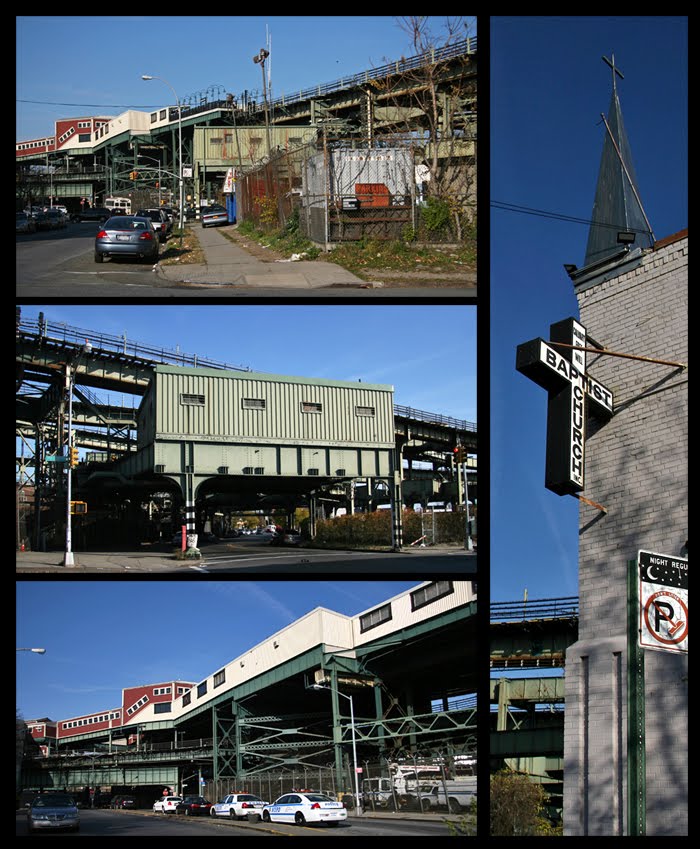
There are some neighborhoods that the visitor to New York City will likely never see and residents outside those neighborhoods will likely never visit either. Brownsville, East New York, Bedford-Stuyvesant and Bushwick are among them. These places often serve as bragging rights for those who grew up there. Surrounded by these neighborhoods is Broadway Junction.

I was literally stopped in my tracks - the tracks of a confluence of trains and a massive, hodgepodge conglomeration of structures with every disparate element imaginable - different colors and materials embellished with chain link fences crowned with barbed razor wire.

This is Broadway Junction, where East New York Avenue, Broadway, Jamaica Avenue, Fulton Street and Interboro Parkway pass, along with subway stations for the A, C, J, L, Z and the Long Island Railroad.

Nearby, at 1520 Herkimer Street, I happened across the Calvary Free Will Baptist Church. A perfect addition to the ultimate juxtaposition...

Thursday, October 21, 2010

The Little


Here, in lower Manhattan, way under the radar and not touristed at all, I discovered a little school on a little alley. In New York City, this is how I find solace, in the diminutive. A little alley, a little crook in the street, a little shop, a little building, a little garden. Feeling a little tired, because one can never really become exhausted from exploring the little, and if it is a beautiful day, perhaps one may enjoy a little rest and a little snack. This is why I choose to live in Greenwich Village, because the scale is so much smaller and so much more human.

I have been in many high rises, and there is nothing quite like the ambiance of a classic prewar building and, if one is so privileged, the views that may come with a residence on an upper floor. Icons like the Waldorf Astoria Hotel or the Plaza just exuded charm. And there is nothing quite so noble as the Chrysler Building at night. But for me, when it comes to a place I call home, I choose the small townhouse.

I have not been to the new Vegas, and I imagine I will get there at some time. And, like Dubai, I also imagine that there will be some shock and awe. However, living in New York City for the last 40 years, I do not seek out the the mammoth or the overwhelming when it comes to man made environments. And although I live in the country's largest city, in my business life I have carved out a little niche. It is much easier to succeed in the proverbial small pond.

At 15 Dutch Street, I was very surprised to find the Downtown Little School. From reading, parents rave about this nursery school and I think the word Little (like the Little Red Schoolhouse on Bleecker Street) is a signal that this place emphasizes caring, personal attention and the human touch, embracing all that was good in the old school.

I was also very surprised to learn that the huge multinational giant, Colgate-Palmolive, had its roots on Dutch Street. In 1806, at 6 Dutch Street, William Colgate opened up a starch, soap and candle factory, a reminder that not only the good, but also the big germinates from the Little :)

Monday, October 11, 2010

The Dark Side


One of the biggest problems with the Internet is cut and paste journalism. The ease of which information can be copied and recycled is unprecedented, whether it be general information, reviews, press releases or buzz. In the case of online news content, as in print media, there is always competition to cover any new event, product, service or retailer. But with online content, the ease and temptation is just too great.

Dead Apple Tours is certainly a clever concept. Started in 2010 by Drew Raphael, the 2 hour tour of the macabre is conducted from a 1960 Cadillac Crown Royale hearse (at $45 per person). From their website: Witness the final address of Heath Ledger, Keith Haring, Sid Vicious, "Crazy Joe" Gallo, Thomas Paine and more. Learn the dark secrets of iconic landmarks: Empire State Building, Washington Square Park and the Brooklyn Bridge.

In going through pages of early reviews, however, apparently none of the reviewers in the major media had actually taken the tour or availed themselves of reviewers who had. All of the reviews appeared to essentially parrot back the buzz and tour information provided by the tour operator.
The most useful reviews were those at Yelp.com, by three individuals who took the tour and reported their experiences:

The narrative descriptions of dead locations were read from a book by our guide in a flat monotone, with all the enthusiasm of an MTA announcement.

Many times we drove up to an approximate area but not to the actual site of the morbid event.

A nice touch would be to drop people off at the train station at the end of the tour, at Fulton Street. The 3 stranded tourists had to ask us for direction to the train in the dark.

There are a staggering number of things to do in New York City, and before spending time and money doing any of them, I would highly recommend looking at the reviews or talking to those who have actually been there and done that. Filtering the reviews and reading them closely is an important part of the process to ascertain why a review is actually positive or negative and relevant to you or not.
If someone is marketing the dead, it's fair to examine not only the light side but also the dark side of the dark side :) :(

Wednesday, September 15, 2010

U Thant Island


I love islands. No matter how small or how close to another land mass, an island always has a feeling of being its own intimate world. When inhabited, there is typically a focused energy, the opposite of suburban sprawl. There is a precious quality to a place where resources and space are very limited and boundaries are well defined. If desirable, this precious quality can reach a fever pitch, where every inch is taken. Like Manhattan.

On the flip side, the uninhabited island is virtually synonymous with remoteness and isolation. And in New York City, you can find both extremes just a stones throw apart.
U Thant Island is New York City's smallest island (100 x 200 feet) and sits only about 1000 feet from Manhattan in the East River, opposite the United Nations and just south of Roosevelt Island. It is diminutive in size but not small in history or fascinating lore.

Belmont Island, as it was known at one time, was built on the granite outcrop, Man of War reef in the East River, from landfill during the construction of the Steinway Tunnels. The landfill was removed from a shaft dug down the reef to the tunnels.

On February 25, 1885, a group of prominent Long Island businessmen incorporated the East River Tunnel Railroad Co. to construct a tunnel railroad from Ravenswood, north of Long Island City, Queens, to Manhattan as a direct connection between the Long Island Rail Road and the New York Central & Hudson River Railroad. At one point, new money was needed to invest in the project and one of the men who became interested was Mr. William Steinway, founder of the Steinway & Sons Piano Co. He owned a sizable part of Long Island City real estate & owned the Steinway and Hunter's Point Railroad which was a local horse car line. By obtaining control of the tunnel company, it would increase the value of his properties. He died in 1896 before the project was completed.

In 1902, August Belmont, Jr. began to take an interest in the project. Belmont was German-born, a banker who had had inherited his fathers vast fortune in 1890 and also a friend of Steinway. The trolley tunnels were finished in 1907 and sold to the city in 1913. The tunnels are still in use today for the number 7 subway Flushing line.

Forgotten for over 70 years, in 1976, a group of employees of the United Nations and followers of Buddhist guru Sri Chinmoy, began to lease the land from New York State for $20 a year. They renamed it U Thant Island, after U Thant, a Burmese diplomat, 3rd UN Secretary General from 1961 to 1971 and friend of Sri Chinmoy. Flowers, bushes and trees were planted and a 30 foot high steel peace arch constructed. Reportedly, there is also a time capsule including pictures and speeches of U Thant.

In 1999, though, the group erected a sign for U Thant, which reads: “Compassion: Home. Dedicated to world peace. Simplicity was U Thant’s life. Sincerity was U Thant’s mind. Purity was U Thant’s heart. His was the approach of serene and illumined dignity."
The island was used occasionally used for meetings and meditation.

In 2004, NYC artist Duke Riley, under the influence of rum, rowed a boat in darkness with a friend, landed on U Thant Island, proclaimed it a sovereign nation and hoisted a 21 foot long pennant flag up the island's navigation tower. On their return to land, they were apprehended by the coast guard but were not arrested. The adventure was videotaped and entitled Belmont Island (SMEACC) - it can be seen here.

Currently, the island is not accessible to the public and is a sanctuary for migrating birds, including a colony of Double-crested Cormorant. I'd like to tell them how lucky they are to have access to U Thant Island :)

Photo Note: I have been obsessed with this small island for ages and it has been in my cross hairs for this website since its inception. Only recently however, on a the pier at Gantry Plaza State Park in Queens, was I able to get a reasonably good vantage point from which to take a photo (upper photo mine, lower photo public archives). I hope to get closer to one day by boat.

Monday, August 23, 2010

Just Around the Corner


Nooks and crannies are not only the obsession of urban jungle lovers and explorers. They are also big business - Thomas' has built a $500 million dollar business around the famed nooks and crannies of their English muffins. Chris Botticella is one of only seven people who knows the entire secret process to produce the legendary muffins with signature air pockets marketed as "nooks and crannies."*

Finding nooks and crannies in a city like New York is just as delightful as a Thomas' English muffin. However, unlike the muffin which can be found in any grocer, special pockets of the city are much harder to locate. I have explored many of these on this website.

The financial district is the oldest area of New York City, and remnants of Nieuw Amsterdam still exist amid the towering structures. In tandem with the areas, extremely narrow streets create a uniquely cavernous feel. The area is largely overlooked by visitors and residents, excepting for the more obvious spots such as South Street Seaport, Ground Zero and Battery Park.

It is remarkable that places like Mill Lane and Stone Street were completely unknown to me until Sunday, while combing the streets of the financial district in the rain. Temporary scaffolding on Mill Lane provided the necessary shelter and an opportunity to see a bit of this historic area in a deserted state. Mill Lane is one of the shortest alleys in New York City. It lies between South William and Stone Streets.

I love turning a corner to a pleasant vista like coming around a hairpin turn on a mountain precipice that opens to a jaw-dropping panorama. Looking around the corner at Stone Street from Mill Lane was a throwback in time. The restored street is a beauty, what the New York Times called "Turning an Alley into a Jewel."

Stone Street was originally known as Brewers Street by the early Dutch settlers. In 1655, when the street was paved with cobblestone, it became known as Stone Street. In the 1980s, the street was divided to make way for the Goldman Sachs building. The short historic block, "a back alley filled with graffiti, a garbage pit; used for low-level drug dealing", was completely restored with redone buildings, New York bluestone sidewalks, new Deer Isle granite paving blocks, and period street lights. Most of the buildings date to 1836, rebuilt following a fire in 1836. In 1996, the eastern portion of the street and surrounding buildings became protected by the New York City Landmarks Preservation Commission as the Stone Street Historic District. It is pedestrian-only.

I look forward to going back in better weather. I recommend taking a stroll down the narrow streets of the area, exploring the nooks and crannies, and looking for that surprise just around the corner :)

*Thomas' was purchased by Bimbo Bakeries USA in 2009. In January 2010, Botticella left the company to work for Hostess Brands, who had been trying to learn the secrets of Thomas' muffins. Bimbo, however, was successful in getting a court order barring Botticella from taking the new position. See the article here.

Thursday, August 12, 2010

Grisly Business


Gino Galestro, a member of the Bonanno crime family, ordered Rober McKelvey to be killed. McKelvey had committed crimes with the family but also angered Galestro and owed him money. Former marine Joseph Young was to make the hit, but things did not go well. From the New York Times, 2006:

The victim was lured to a secluded landmark, a Victorian mansion on a hilltop on Staten Island, but he proved hard to kill. When an effort to strangle him failed, he was stabbed, then dragged to a nearby pond and drowned. His body was dismembered with hacksaws and incinerated in the mansion's furnace.

Since that time, all manner of ghostly and poltergeist phenomena have been claimed (and some prior to that murder, where legend has it that a cook killed himself in the kitchen).
The mansion was built in 1885 as an estate home by New York City brick manufacturer Balthazar Kreischer, a Bavarian immigrant. Two other homes like it were built for his two sons, Charles and Edward, who were partners in the company B. Kreischer & Sons. Only one home remains, shown in the photo and located at 4500 Arthur Kill Road, Staten Island.
The area, settled by the Androvette family in 1699, was originally known as Androvetteville in the 1700s. It then became known as Kreisherville, a factory town built by Kreischer, who had been attracted by the natural clay deposits in the region*. From the New York Times:

At the height of its operation in the late 1890's, B. Kreischer & Sons employed more than 300 workers and turned out more than three million bricks yearly. Kreischer brick, which continued to be produced until the 1930's, was used on major building projects throughout New York. Kreischer decorative terra cotta was used in the building of Barnard College around 1900.

The brick factory was built in 1854, destroyed by fire in 1877, rebuilt, and finally closed in 1927. Kreischer brickwork can be seen in neighborhoods as far away as Ridgewood and Astoria, Queens.
With the anti-German sentiment after WWI, the town name was changed to Charleston after Kreischer's son, Charles. In 1996, the home was a restaurant. Currently vacant, there are plans to build a 120-unit senior citizen housing near Kreischer Mansion, which may be used as a center. I hope we are finished with all the grisly business...

*The 260-acre Clay Pit Ponds State Park Preserve is located on the site that once provided the white kaolin clay in the 19th century for the manufacture of bricks and terra cotta.

Wednesday, August 11, 2010

White House of Ill Repute


The White House has had its Presidential scandals. Much has been well documented, and the home can be seen in photos everywhere.
However, there is another White House riddled with much darker doings in the past, located at 177 Benedict Road in Staten Island, NY, the former home of the notorious crime boss Constantino Paul Castellano. I journeyed to Staten Island to see the place for myself, and I believe these are the only photos you will find of this home.

In 1976, Big Paul Castellano succeeded Carlo Gambino (after his death) as head of the Gambino crime family, the largest Mafia family at the time in the United States.
Paul was born in Brooklyn in 1915, the youngest of three. He dropped out of school in the eighth grade and learned to be a meat cutter in his father's butcher business. His life of crime began early - Paul also ran numbers for his father.

In the 1920s, Staten Island was sparsely populated and isolated - an ideal dumping ground for mafia victims as well as a place for bootlegging, extortion, loansharking, gambling, drug-dealing and smuggling, activities that emerged on the waterfront. By the mid-20th century, Staten Island became a residential enclave for Mafia dons, providing the seclusion they needed. In the 1980s, law enforcement officials estimated the number of "made" Mafia members living on Staten Island at around 60, with names like John Gotti, Aniello Dellacroce, Salvatore Gravano, Frank DeCicco, Thomas Pitera, Costabile Farace and many others.
Castellano's enormous mansion, a replica of the White House of the United States, was built in 1980 in Todt Hill on Staten Island.

At the time Castellano moved into this estate with his family, a Columbian housemaid, Gloria Olarte, began working. A full-blown love affair between Paul and Gloria developed under the eye of Castellano's wife, Nina. Although Mafiosi are known to keep a goomatta on the side while married, Castellano's behavior became more overt and problematic.
Knowing that Castellano conducted business from his home, the FBI planted bugs in Castellano's home in 1983 with the help of Olarte, who had been upset with the way her affair with Paul was going. Olarte let an FBI agent into their home, posing as a repairman. Over 600 hours of conversations detailing the Gambino family business were recorded.

Others in the organization were also not pleased with Castellano and his more mainstream business approach. On Dec. 16, 1985, Castellano and his driver, Thomas Bilotti, were murdered outside of Sparks Steak House at 210 East 46th Street, between Second & Third Avenues in Midtown Manhattan. The hit was ordered by John Gotti, who controlled the family until his 2002 death in prison. The gangland style murder was particularly shocking, occurring as it did during rush hour, in midtown Manhattan, and in modern times.

Not to be upstaged, New York City is proud to be home to its own White House of Ill Repute :)

Monday, August 09, 2010

Veneer of Their Lives


From time to time, I need a reality check to put things in perspective. At one time, I occasionally turned to a good friend who had moved to the West Coast. He had a very worldly perspective, having traveled extensively to all corners of the globe. See Weather Means Whether here.

As I have written in stories like The Dark Ages, New Yorkers often have to tolerate very poor living conditions, even when paying substantial rents or purchase prices for apartments. Among residents, this is often a source of humor, jokes and sarcasm. The non-resident or visitor often sees displays of wealth in New York, but these glimpses of the city are just a veneer and often do not give the full picture.

The single biggest factor in living in this city, regardless of whether a person owns or rents, is that with little exception, the vast majority of residents live in multiple-unit dwellings, i.e. apartment buildings. In this environment, you lose control. Tenants above, below, and to the sides of you are a perennial concern and often a source of noise etc., frequently with little recourse.
On one occasion, said friend was in my apartment when I was feeling particularly shut in and frustrated by my various living conditions. Having a sense, however, that things could be much worse and that perhaps I was rather an ingrate, I asked him his honest assessment of my abode. After a moment or two of thoughtful contemplation, he said that in the scheme of things, I had a pretty good situation.

Romanticizing the past can also be a case of seeing only a veneer. In Better When, I discussed the illusory sense that times were better in the good old days.
Strolling through St. Luke's Cemetery, on Arthur Kill Road in the Rossville section of Staten Island, provided the reality check I needed. A photographer friend who accompanied me pointed out how many grave stones of children there were. (If you click to enlarge the photo, you can read the inscriptions). As we strolled the graveyard, I found it quite sobering, particularly the family of Morris and Eva Dixon, whose many children lived only some months to 3 years. I was heartened by their own headstone (lower right photo), noting that they were born 3 years apart (1855 and 1858) and died within one year of each other (1929 and 1930). I hope the Dixons had their joys as well as misfortunes and that these headstones serve only as a veneer of their lives...

Friday, July 23, 2010

Paint by Number


There is nothing that seems to make an artist bristle more than paint by number* or anything remotely resembling it. It is useful to know what is best left to subjective human judgement. However, it is also good to know what is best done by using numbers, as well as where using numbers is more efficient and does not degrade the human experience.

I recall a documentary on the illy coffee company of Italy. What really impressed me was the balance between the subjective and objective in their coffee production process. There are things better done using science and technology and things better done by the human senses, and the illy family knows when to use what.

Numbers lie behind most things, and ultimately, given fine enough resolution, many analog things can be reduced to a digital file with satisfying results. Music is a good example. Most musicians have embraced digital recordings. Whether or not they are absolutely identical to an analog recording and whether there are any audible differences are moot points for most - the digital files communicate well the feelings intended by the composer and performers, the primary feature being the ability for flawless reproduction.

There are things that appear to resist reduction to digital reproduction and are controversial. Stradavarius, Guarneri and Amati violins are a good example - these instruments are highly coveted by violinists. However, tests have been done using antique and new instruments, with mixed results as to the ability of some of the world's greatest musicians and experts to distinguish the old from the new by listening alone.

Along with music, imaging and photography have been most greatly impacted by the digital process. The fact that a scene like that in today's photo can be effectively communicated with a digital file is remarkable. I stumbled upon this exquisite little gingerbread cottage while driving through the Lighthouse Hill neighborhood in Staten Island. The home, at 298 Lighthouse Hill Avenue, neighbors the Tibetan Museum and shares the same hillside and vistas (see second photo here). Built in 1899, the house is only 968 square feet. Its diminutive size and idyllic charm is communicated easily, whether you take photos, brush by instinct, or paint by number :)

*About Paint by Number: The 1950s in America saw a rise in prosperity and leisure time. "For critics, the paint-by-number phenomenon provided ample evidence of the mindless conformity gripping national life and culture. The making of the fad is attributed to Max S. Klein, owner of the Palmer Paint Company of Detroit, Michigan, and to artist Dan Robbins, who conceived the idea and created many of the initial paintings. Palmer Paint began distributing paint-by-number kits under the Craft Master label in 1951. By 1954, Palmer had sold some twelve million kits. Popular subjects ranged from landscapes, seascapes, and pets to Leonardo da Vinci's The Last Supper. Paint-kit box tops proclaimed, 'Every man a Rembrandt!' " Read more here.

Wednesday, July 21, 2010

Todt Hill


If you enjoy exploring New York City, then Todt Hill is a must. This residential hilltop neighborhood is certainly one of the most, if not the most, exclusive, secluded areas in the five boroughs of New York. Todt Hill, with an elevation of 410 feet, is the highest natural point on the Eastern Seaboard of the United States south of Maine.

Staten Island is also the least populous of New York's five boroughs, with under 500,000 residents. This much lower population density and its very hilly terrain create some very rural and remote feeling areas.

I love hill and mountain tops, and Todt Hill had been on my list for quite some time, having only passed through the area once before a long time ago. On this trip, I explored the backroads and (along with Forest Hills Gardens, Bayside, Queens and Dyker Heights, Brooklyn) found it to have some of the most extraordinary private homes in New York City - McMansions abound with topiary, bricked semicircular driveways, and fountains. See my photo gallery here.

Most of Staten Island has a decidedly suburban feel - driving there is more akin to nearby New Jersey than New York City, with much of the developed areas of the borough revealing a plethora of strip malls and other visual clutter.

Do not be misled, however. Staten Island has some of the most beautiful natural and historic environments in New York City - places like St. Andrews Church, historic Richmond Town, Snug Harbor, the Museum of Tibetan Art, the Kreischer Mansion, The Crimson Beech (residence designed by Frank Lloyd Wright), yacht clubs, waterways and estuaries, the Latourette House (1836), Staten Island Botanical Garden, and the Fresh Kills landfill. This massive landfill, opened in 1947 and closed in 2001, has been cleaned up and is now undergoing development into a park larger than Central Park - plans include a bird-nesting island, boardwalks, soccer and baseball fields, bridle paths and a 5,000-seat stadium.

But, if like me, you really like lofty pursuits, head for Dongan Hills, Grymes Hill, Lighthouse Hill and Todt Hill :)


Friday, July 09, 2010

Fire Island


With only one exception, all the photos on this website were taken in one of the five boroughs in New York City. I do not vacation or travel out of the city or post photos and stories of my exurban adventures or vacations.
But Fire Island is a special case, and if you don't include it in your discussions about New York City, then you do not have a complete picture of this city. Like the Hamptons and Montauk, Fire Island is a summer playground dominated by New Yorkers, particularly Manhattanites. There is a level of urbane sophistication - if you spend time there, you quickly get a real sense that this is a virtual microcosm of New York City.

Fire Island is a barrier island, only half a mile wide and 31 miles long, off the south shore of Long Island. It is accessible by bridge at either end with public beaches - Robert Moses State Park at the western end and Smith Point County Park at the eastern end.

However, the real allure are the 22 some odd private communities that dot the interior of the island, which are only accessible by ferry from Long Island. These communities span an entire range of environments and people, from conservative to wild. Point of Woods has the character of a New England town, Fire Island Pines has roller coaster boardwalks tunneling through trees. Cherry Grove is dominated by the gay community, with a party atmosphere. Seaview is sedate. Ocean Bay Park sees many vacationers sharing homes. Water Island has the character of a remote outpost. See my photo gallery here.

My romantic love affair with Fire Island started on a day trip in the early 1970s. I immediately was swept away. There are many charms to Fire Island - the pristine beach and dunes, protected as Fire Island National Seashore, Sailors Haven, the Sunken Forest, and Fire Island Lighthouse. But there is one big factor that defines everything - there are no automobiles.

This is an extraordinary world where streets are often wooden walkways, transportation is by foot or bicycle, and goods are frequently carted by wagons left in town. Here, you can find the occasional little girl with a stand selling shells. Deer roam freely and can be easily hand fed. Less than 40 miles from New York City and the quiet is just shocking.

Sound like paradise? Yes it is. If you have a chance, visit Fire Island :)